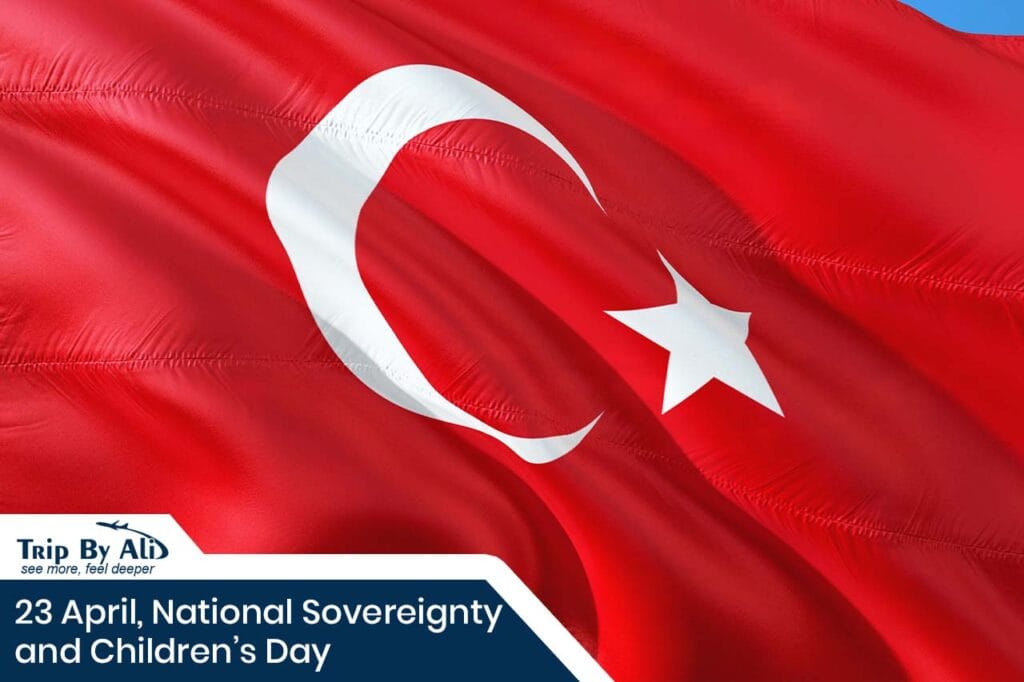
If you visit Türkiye (formerly known as Turkey) in late April, you may notice something unusual in the atmosphere. City squares feel more festive, schoolyards fill with songs and performances, Turkish flags appear across neighborhoods, and children seem to stand at the center of public life. That is because 23 April, known in Turkish as Ulusal Egemenlik ve Çocuk Bayramı, is one of the country’s most meaningful national holidays. It is not only a day of celebration, but also a day of memory, identity, and national symbolism rooted in the modern history of the Turkish Republic. The holiday is observed every year on 23 April and commemorates the opening of the Grand National Assembly of Turkey in Ankara on 23 April 1920, a defining moment during the Turkish War of Independence.
What makes this holiday especially striking for international visitors is that it combines two ideas that are rarely joined in one national celebration: sovereignty and childhood. In Türkiye, the day honors the principle that national power belongs to the people, while also celebrating children as the future of the nation. Over time, this gave 23 April a distinctly emotional and public character. For travelers from the United States, Europe, and elsewhere, understanding this day adds depth to any spring visit to Turkey because it reveals how history, civic identity, and family life come together in everyday Turkish culture.
What Is 23 April in Türkiye?
23 April in Türkiye is officially known in English as National Sovereignty and Children’s Day. It is a national public holiday, which means schools and government offices are closed, and many formal and informal celebrations take place throughout the country. The historical reason behind the date is clear: on 23 April 1920, the Grand National Assembly first convened in Ankara, creating a new center of political legitimacy at a critical time for the future of the country. For modern Turkey, this moment came to symbolize the transfer of authority to the nation itself.
Yet the holiday is remembered by most people not only as a constitutional or political milestone, but also as one of the most joyful days of the year for children. Mustafa Kemal Atatürk later dedicated the day to children, and Türkiye is widely described as the first country to establish an official national holiday centered on children. That combination gives 23 April its special place in Turkish public life. It is solemn in meaning, but warm in tone. It is patriotic, but also deeply family-oriented. This is exactly why visitors often find it memorable: the day feels both ceremonial and genuinely heartfelt.
The History Behind the Date
To understand why 23 April matters so much, it helps to place it in the turbulent years that followed the collapse of the Ottoman Empire after World War I. In 1920, as political control fragmented and occupation pressures intensified, the opening of the Grand National Assembly in Ankara represented more than a parliamentary meeting. It marked the emergence of a new political center that claimed to speak for the nation during the struggle that would eventually lead to the creation of the Republic of Turkey. Because of that, the date became permanently associated with the idea of national sovereignty, meaning that the authority of the state belongs to the people rather than to a dynastic ruler.
The children’s dimension came later, but it was not a random addition. Atatürk’s decision to connect this national turning point with children reflected a broader republican vision of modernity, education, and the future. By dedicating the holiday to children, the message became symbolic as well as political: a nation secures its future not only through institutions, but through the generation growing up to inherit them. This idea still shapes the character of 23 April today. Even when the holiday includes performances, music, and colorful public events, the deeper meaning remains visible beneath the festive atmosphere.
Why Children Are at the Center of the Celebration
For first-time visitors, one of the most distinctive parts of 23 April is the visibility of children in official and symbolic roles. In Türkiye, children do not merely appear as spectators on this holiday. They are presented as the main protagonists of the day. This is why school performances, youth ceremonies, children’s choirs, and public speeches aimed at younger generations are so common. In many places, the holiday becomes a national reminder that children are seen not only as family members to be protected, but as citizens of the future whose education, confidence, and well-being matter to the entire country.
This symbolism also appears in one of the holiday’s best-known traditions: children ceremonially taking the seats of public officials for the day. In different years and locations, children may symbolically sit in parliament or represent mayors, governors, and other public figures. For an outside observer, the practice may seem playful, but its message is quite serious. It dramatizes the idea that the future of the country belongs to the next generation. That is one reason why 23 April feels different from many national holidays elsewhere. It does not only commemorate the past; it performs a vision of the future in public.
How 23 April Is Celebrated Across Türkiye
In practical terms, 23 April celebrations often begin in and around schools. Students prepare songs, poetry recitations, folk dances, choreographed performances, and themed ceremonies for weeks in advance. Turkish flags, red-and-white decorations, classroom displays, and children’s costumes are all part of the visual language of the day. In many neighborhoods, especially where families with school-age children are numerous, the atmosphere becomes festive from the morning onward. Even if you do not attend an official event, you can usually feel that the day carries public importance.
At the same time, the holiday also has a more formal national dimension. Wreath-laying ceremonies and commemorations linked to Atatürk and the foundation of the assembly take place, especially in Ankara. The largest symbolic focus is often on the capital, where the connection to parliament and the early republican period is strongest. Beyond Ankara, municipalities, cultural centers, shopping malls, public squares, and family venues often organize their own child-focused events. As a result, 23 April can feel both local and national at once: a state holiday expressed through neighborhood-scale joy.
Visiting Türkiye in Spring? Don’t Miss the Meaning Behind 23 April
Discover how one of Türkiye’s most important national holidays brings together history, family life, and public celebration.
If you want to experience the country beyond the usual tourist checklist, 23 April offers a rare cultural window.
The International Side of 23 April
Another reason 23 April attracts international interest is the long-running TRT International Children’s Festival, which has brought children from many countries to Türkiye over the years. This festival, organized by Türkiye’s public broadcaster TRT since 1979, helped expand the holiday’s image beyond a purely domestic national celebration. It introduced a message of cultural exchange and goodwill, presenting 23 April not only as a Turkish holiday for Turkish children, but also as an occasion to celebrate friendship among children from different countries.
For foreign readers, this international dimension is especially useful because it explains why the holiday is often described in Turkish public discourse as both national and universal. The national side comes from sovereignty and the 1920 opening of parliament. The universal side comes from the way children are imagined as a shared global future. That balance is part of what makes the day culturally interesting for travelers. It is deeply rooted in Turkish history, yet it is also presented in a language that international visitors can easily understand: peace, youth, and hope.
What Travelers Should Expect on 23 April
If you are in Türkiye on 23 April, the first thing to know is that it is a public holiday. Government offices and schools are closed, and some business routines may change depending on the city and neighborhood. Public transportation can also be affected by parades, ceremonies, or temporary street closures in areas with official events. For that reason, travelers should avoid planning the day too tightly, especially if they need administrative services or time-sensitive local errands.
The good news is that for most leisure travelers, the holiday is more enriching than inconvenient. Many commercial areas, promenades, family venues, and shopping centers remain active, while public spaces often feel more colorful and animated than usual. If your trip style includes cultural observation, local photography, or simply experiencing how public life works in Turkey beyond the classic monuments, 23 April can be one of the most revealing days to be in the country. It offers a softer, more human view of Turkish identity than what many visitors encounter through headline history alone.
Where to Experience the Holiday Best
Ankara carries the deepest historical meaning because the day is directly tied to the opening of the Grand National Assembly there in 1920. Travelers interested in modern Turkish history, republican symbolism, and official ceremonies will find the capital especially rewarding on or around 23 April. The connection to parliament and to major commemorative rituals makes Ankara the most historically resonant place to understand the political meaning of the holiday.
Istanbul, however, may be the easiest city for international visitors to experience the festive and family-centered side of the day. Because of its scale and variety, the city often offers more visible public programming in malls, parks, museums, cultural venues, and district municipalities. For families traveling with children, Istanbul can be particularly appealing around 23 April because the holiday fits naturally with museums, waterfront promenades, and urban spaces that already cater to younger visitors. GoTürkiye has also highlighted child-friendly museum experiences in Istanbul in connection with the holiday, which reinforces that family-travel angle.
Why 23 April Matters Beyond the Holiday Itself
Some national holidays are easy to observe but hard to interpret. 23 April is the opposite. Even if you know nothing about Turkish history before arriving, the structure of the day tells you a lot about the country’s self-image. It tells you that public sovereignty matters to the republican story, that Atatürk remains central to civic symbolism, and that children are treated not only as members of private families but as part of the national imagination. In that sense, 23 April is one of the clearest windows into how modern Türkiye explains itself to itself.
Want to explore more about Istanbul? Start your journey from the Trip by Ali homepage.
FAQ: 23 April in Türkiye
Is 23 April a good day for tourists to be in Türkiye?
Yes, especially for travelers who enjoy culture, public celebrations, and local atmosphere. It may not be the best day for paperwork or formal appointments because it is a public holiday, but it can be an excellent day for observing Turkish civic life and family-oriented celebrations in a more authentic way than usual.
What exactly happened on 23 April 1920?
On 23 April 1920, the Grand National Assembly of Türkiye opened in Ankara. This became a foundational moment in the country’s modern political history and is the reason the date is associated with national sovereignty.
Why is it also called Children’s Day?
The day was later dedicated to children by Mustafa Kemal Atatürk, linking the idea of national sovereignty with the future of the nation. Over time, that made children central to the celebrations and helped establish Türkiye’s reputation as the first country to create an official children’s holiday at the national level.
Are museums, restaurants, and shops open on 23 April?
Many restaurants, shopping centers, and visitor-oriented businesses remain open, but schools and government offices are closed and some public services may operate differently. Travelers should check transport routes and local schedules if they plan to move through ceremonial areas.
Where should I experience 23 April: Istanbul or Ankara?
Choose Ankara if you want the strongest historical and official context. Choose Istanbul if you want a broader family-travel atmosphere with more visible citywide variety. Both can be rewarding, but they offer different versions of the holiday experience.
Planning a Trip to Türkiye Around a National Holiday?
From cultural celebrations to local travel timing, understanding Turkish holidays helps you travel smarter and experience more.
Written by Ali Rahnama — Local Eco Tour Guide and Travel Storyteller.
Explore my Google Maps contributions •
Discover more at Trip by Ali.